Threads, Ractors and Fibers in Ruby 4: what I learned by measuring before building a mail server
I’m starting a personal project: Mailractor, a mail server written in Ruby. Before writing a single line of SMTP, I wanted to answer the question that shapes the whole architecture: which of modern Ruby’s concurrency models can handle this kind of load?
Ruby 4 has three answers on the table:
- Threads: the classic model, limited by the GVL (only one thread runs Ruby code at a time).
- Ractors: real parallelism with memory isolation, behind an API that changed quite a bit in Ruby 4.0.
- Fibers with a scheduler (
Fiber::Scheduler, here through theasyncgem): cooperative concurrency, one event loop per thread.
Instead of picking one by gut feeling, I built a benchmark POC. This post sums up what I measured, what surprised me and the Ruby bugs I hit along the way (one of them became Bug #22439). All the code, raw results and the full report are at github.com/amalrik/ruby-ractors-study.
How I measured
A few rules I followed so the numbers wouldn’t fool me:
- Same work and same validation in every mode. Prime counting is checked against a sieve of Eratosthenes. Every network session is validated reply by reply.
- Each case runs in a fresh Ruby process, with a warm-up round and 3 to 5 repetitions. I report the median and min/max, never just the best run.
- Startup, processing and shutdown measured separately, along with CPU, memory (peak RSS) and p50/p95/p99 latency.
- The environment is recorded on every run: CPU, Ruby version and, in the cloud, steal (CPU time the hypervisor hands to other virtual machines).
The machines: a laptop with a Ryzen 7 5700U (8 cores/16 threads) and, later, a VM on Hetzner (CPX42, 8 AMD EPYC vCPUs). I ran everything on Ruby 4.0.6 and repeated it on 4.0.7 and 4.1.0-preview1. The version made all the difference.
1. CPU: Ractors deliver, threads don’t
The first test is the most predictable one: counting primes among 2 million numbers, split into independent blocks.
| Mode (Ruby 4.0.6, 512 blocks) | Time | Speedup |
|---|---|---|
| sequential | 3.17 s | 1.0× |
| 8 threads | 3.10 s | 1.02× |
| 8 Ractors | 0.59 s | 5.4× |
| 16 Ractors | 0.59 s | 5.4× |
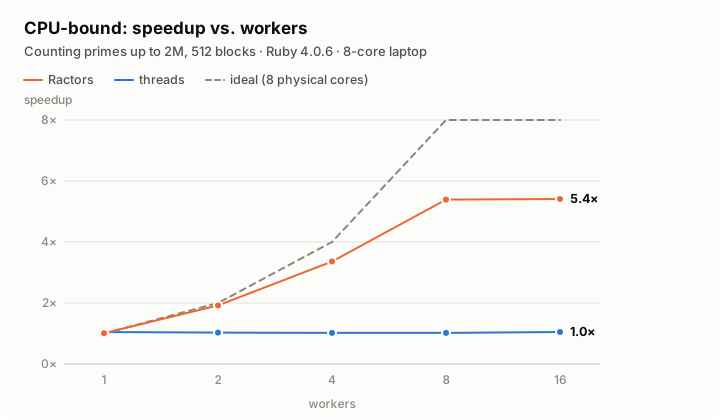
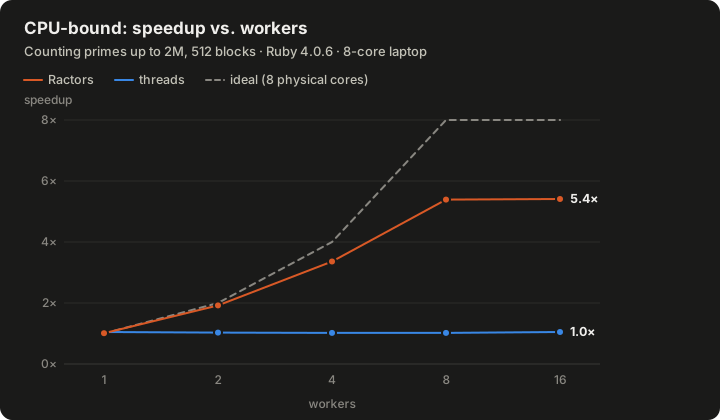
Threads don’t help at all with pure Ruby: the GVL serializes execution. Ractors scale up to the number of physical cores. Creating a Ractor costs ~45 µs, so startup cost is negligible.
Two interesting details:
- 16 Ractors are no better than 8. On 4.0, the scheduler uses at most
RUBY_MAX_CPUnative threads (8 by default). Raising it to 16 made things slower (0.70 s): the SMT logical cores don’t pay off for this kind of loop. - Granularity matters. With ~0.4 ms tasks, message passing already costs 8% even with a single Ractor. With tasks of a few milliseconds, that cost disappears.
2. I/O: the “receive before I/O” trap
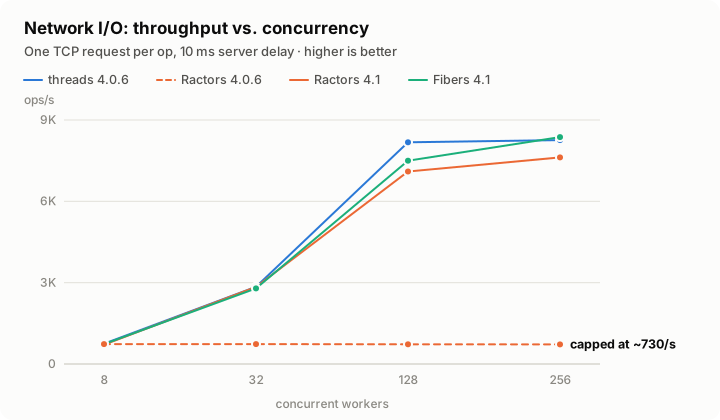
For I/O, I simulated operations that wait on the network: each operation opens a connection to a local server that answers after 10 ms.
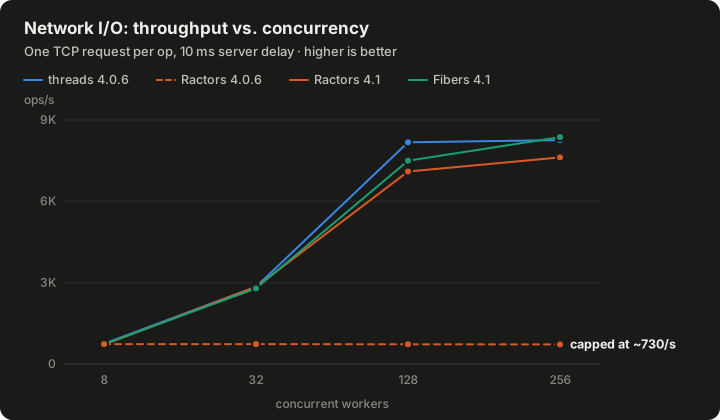
Threads did great: with 256 threads, ~8,200 operations/s. Ractors, on the other hand, got stuck at ~730 operations/s, with either 8 or 256 workers. The server never saw more than ~15 concurrent connections.
I went looking for a mistake on my side. The Ractor pool had a central dispatcher, and I suspected it, then Enumerator#next. It was neither. The clue came from counting the process’s native threads:
| Ruby 4.0.7, 64 Ractors, 400 operations | Time | Native threads |
|---|---|---|
| Ractor goes straight to I/O with a timeout | 0.12 s | ~67 |
Ractor waits on Ractor.receive and then does I/O | 0.59 s | 10 |
In Ruby 4.0’s M:N scheduler, a Ractor that has already blocked waiting for a message (exactly what every pool worker does) doesn’t get a dedicated native thread. From then on, each wait_readable(timeout) holds one of the ~8 shared threads. The result is an invisible cap of ~8 concurrent I/O operations. Nothing warns you: the program just gets slow.
The good news: it’s fixed in 4.1.0-preview1 (0.104 s, with ~18 native threads). The reproducer is in io_bound/bin/repro_ractor_receive_first.rb.
3. SMTP-like sessions: where things get serious
One request per connection doesn’t represent a mail server. So I built sessions with 7 round trips (banner, EHLO, MAIL, RCPT, DATA with 4 KB, QUIT), with a 10 ms wait before each reply and a timeout on every read, as a real SMTP server needs.
Up to ~1,000 concurrent sessions, threads and Fibers tie. Beyond that, the bottleneck changes nature. With 10,000 sessions on Ruby 4.0.6, Fibers delivered 745 sessions/s, and the session p50 was 12.9 s. That’s Little’s law at work:
average latency ≈ concurrency ÷ throughput = 10,000 ÷ 745 ≈ 13.4 s
In other words, latency turned into queueing. A single Ruby process saturates one CPU core, and sessions wait their turn. Measuring CPU alongside latency is what revealed it; without cpu_util, I’d have blamed the network.
Other numbers that matter for a server with thousands of connections:
- Threads: with 10,000 sessions, 646 MB of memory and ~6 s just to create the threads.
- Fibers: 357 MB and 0.1 s to create.
- On 4.1, Fibers got much better under high concurrency: 10,000 sessions in 10.0 s, against 40.4 s on 4.0.6.
4. The test that matters: the server
So far I had been comparing client models. But Mailractor’s question is about the server. So I made the server pluggable and kept the load generator fixed:
- threads: one thread per connection;
- fibers: one process, one Fiber per connection;
- prefork + fibers: 4 processes (fork) accepting on the same socket, each with its own event loop;
- Ractors + fibers: 1 process, 4 Ractors, each with its own listening socket (
SO_REUSEPORT, the kernel spreads connections) and its ownasyncreactor.
I ran it on a throwaway Hetzner VM (it cost cents), with 4 vCPUs for the server and 4 for the generator. Steal stayed at 0% in every measurement. Results with 10,000 concurrent sessions (Ruby 4.1.0-preview1):
| Server | Sessions/s | p99 | CPU (case) | Memory |
|---|---|---|---|---|
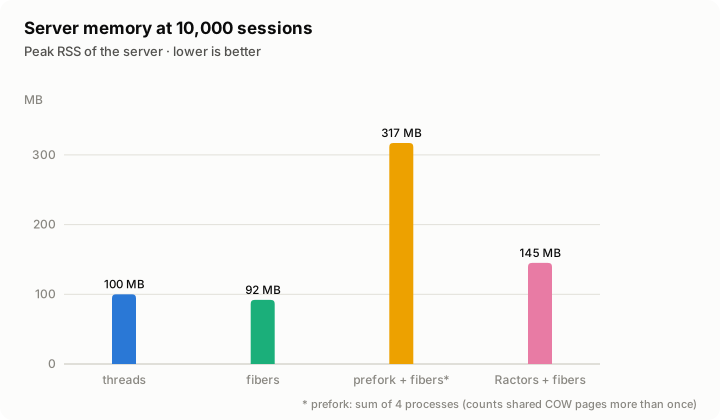
| threads | 1,460 | 7.2 s | 124 s | 100 MB |
| fibers (1 process) | 3,749 | 2.7 s | 32 s | 92 MB |
| prefork + fibers | 12,430 | 0.44 s | 37 s | 317 MB* |
| Ractors + fibers | 9,702 | 1.0 s | 45 s | 145 MB |
* sum of the 4 processes, which counts pages shared through copy-on-write more than once.
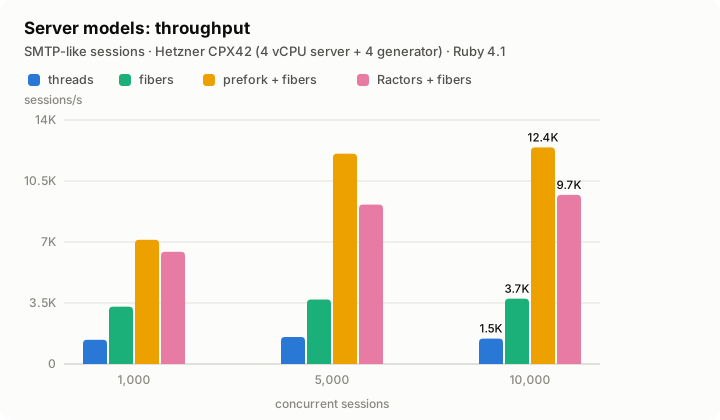
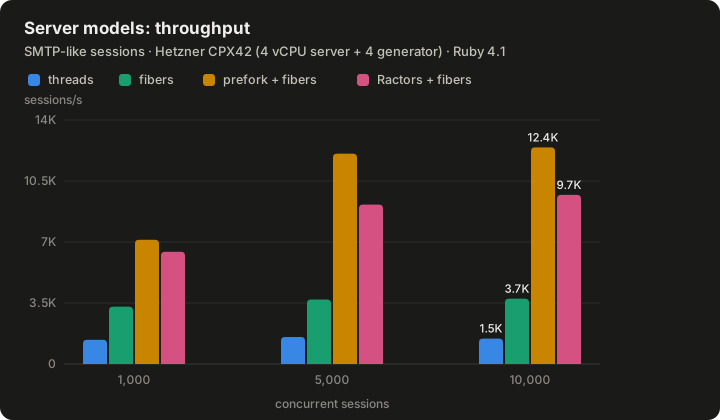
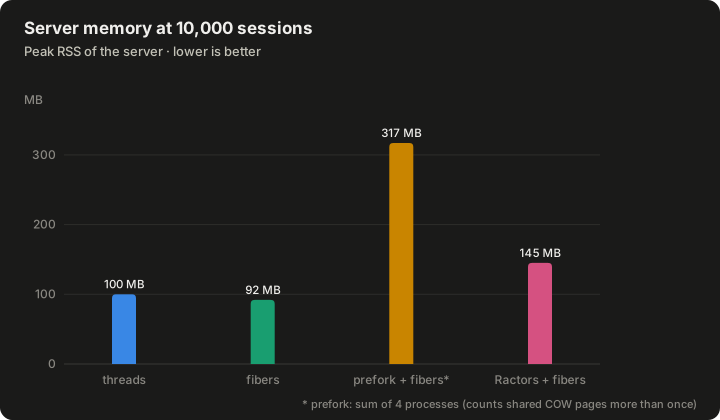
A second run confirmed the ranking. My reading:
- Thread per connection doesn’t work for inbound SMTP. With 10,000 clients, the threads server never went past ~1,000 concurrent connections and burned 3–4× more CPU per session.
- Fibers in a single process are great up to ~1,000 sessions, then get stuck on one core.
- Prefork + Fibers was the fastest, the most stable, and it works on any Ruby version. It’s the established model in the ecosystem (Falcon, Puma in cluster mode).
- Ractors + Fibers reached ~80% of prefork with half the memory, in a single process.
5. Ractors + Fibers: real parallelism inside one process
That last point is the one that intrigued me most. In the same process, with plain Fibers, the limit is one core (~3,700 sessions/s). With 4 Ractors, each running its own event loop, it reached ~9,700/s. On the client side, the process used 4.6 cores at the same time.
It works because:
- Each Ractor has its own execution lock. The GVL is no longer global across Ractors, so threads in different Ractors run on different cores.
- The Fiber scheduler is per thread. Each Ractor installs its own: N independent event loops, one per core, like a server with one loop per core, but without fork.
- No shared socket. Each Ractor opens its own listener with
SO_REUSEPORT, which respects the isolation.
So why does prefork still win? My hypothesis, not measured yet: Ractors share the same heap and the same garbage collector. GC and some internal caches need synchronization between them. Separate processes coordinate nothing. That matches the ~20% higher CPU cost per session. If GC and those caches become more independent across Ractors in future versions, the gap should shrink.
6. The bugs I found along the way
A study like this ends up, unintentionally, being a stress test of the language itself.
Ruby 4.0.6 and 4.0.7: hangs and memory corruption. Session clients running in Ractors hung in 6 out of 20 runs on 4.0.6 and in 4 out of 20 on 4.0.7. Under gdb, the threads were sitting in poll with a timeout, but the timeout never fired (with IO#timeout = 2, the process sat still for 60 s). Network queues were empty on both ends. One run ended in double free or corruption inside the GC sweep. On 4.1.0-preview1: 0 out of 40.
Ruby 4.1: a regression. Running async in several Ractors, a process died with a segfault. I kept shrinking it until I got ~15 lines, with no gems at all:
1
2
3
4
5
6
7
8
9
10
11
12
13
rs = Array.new(2) do |i|
  Ractor.new(i) do |id|
    500.times do |k|
      begin
        raise ArgumentError, "failure #{id}-#{k}"
      rescue => e
        e.detailed_message(highlight: false)
      end
    end
    :ok
  end
end
p rs.map(&:value) # 4.0.x: [:ok, :ok] — 4.1: [BUG] Segmentation fault
On 4.1, error_highlight (that ^^^^ under the failing line) started using a new method, Thread::Backtrace::Location#syntax_tree. Called from two Ractors at the same time, it brings the VM down. With a single Ractor it doesn’t crash, but the highlighted snippet silently disappears. I reported it as Bug #22439, with reproducers and a per-version table. It matters because any library that logs exceptions from inside Ractors can crash the process on 4.1.
7. Method mistakes I made (and fixed)
I’m writing these down because benchmarks lie easily:
- Contaminated measurements. Once, another benchmark ran in parallel with mine and competed for CPU. I had to throw away and redo part of the matrix. Lesson: make sure the machine is idle before measuring.
- I blamed my home network too early. From Brazil to the VM in Finland, sessions had connection timeouts. At first I thought it was the load generator. Then I tried opening 400 connections at once: zero failures. The problem only showed up with sustained rates of new connections, and the server’s kernel counters showed zero drops. SYNs were getting lost on the way (router or ISP). In other words, testing from home was measuring my network, not the server.
- A pretty hypothesis that didn’t hold. I suspected the order in which connections were closed (TIME_WAIT on the server + NAT reusing ports) was causing the losses. I tested both orders: same symptom. Hypothesis discarded.
Conclusions for Mailractor
- Default model for receiving mail: processes (prefork) + Fibers. More throughput, lower tail latency, works on any Ruby.
- Ractors + Fibers is a real alternative on Ruby 4.1, when memory and shared state in a single process weigh more than ~20% of throughput. It’s also the path that produces the most useful feedback for the language.
- Ractors for pure CPU work (MIME parsing, signatures, filters) already work well, even on 4.0.
- Ractors with sockets on 4.0.x: avoid. Concurrency cap, hangs and memory corruption.
- Thread per connection: no.
What I still want to measure: generator and server on separate machines, TLS (STARTTLS changes the CPU cost per session), larger messages and the full pipeline (reception → durable spool → workers). That’s for the next posts.
If you work with Ractors or async, the repository is open: github.com/amalrik/ruby-ractors-study. Criticism of the methodology is very welcome.